English
 Cymraeg
 Français
We are delighted to announce that we will lead a consortium aimed at empowering Malagasy communities to preserve, protect and develop one of Madagascar’s most important and most threatened forests.

The Darwin Initiative* is providing almost £800,000 for our ‘Locally-led Environmental Stewardship to Protect Madagascar’s Forests and Communities’ (LESTEP MFC) programme, under which we will, with our partners Sadabe, the University of the West of England, and the Regen Network, work with 1,000 farming families living on the edge of the Tsinjoarivo-Ambalaomby Protected Area**.
The Area, a 26,500-hectare site, is in the Central Highlands and is effectively, because of its elevation, an ‘island’ of exceptional biodiversity.
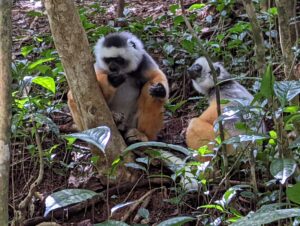
It is home to ten species of lemur – three, the Diademed Sifaka, the pale fork-marked lemur and Sibree’s dwarf lemur, critically endangered – as well as endangered ducks, fish, palms, orchids and frogs. And that is what we know of: new species are regularly discovered in Madagascar’s increasingly fragmented forests and wilderness, one of many reasons they must be preserved and protected.
Tsinjoarivo-Ambalaomby is protected for a reason: it has experienced deforestation at an alarming rate, and if it continues at its current pace, it will disappear entirely within 20 years.
This deforestation has many drivers, but one is the lack of food security faced by Malagasy communities, made worse in recent years by the impacts of the climate catastrophe.
Madagascar is the world’s fourth-poorest country, and 90 per cent of its population live on or below the global poverty baseline of £2.22 per day. The vast majority rely on agriculture for income and to provide food for themselves and their families, and 1.32m Malagasy people are experiencing ‘intense hunger’.
As their land loses fertility or is affected by the impacts of climate change, it becomes increasingly tempting, even necessary, to remove forest to create more .
In response, our five-year project will tackle the drivers of deforestation by empowering local communities to become architects and managers of their own conservation future.
We will establish a pioneering, sustainable ‘Environmental Stewardship Scheme’ where farmers are rewarded for implementing sustainable land management practices, funded by the global sale of verified biodiversity and ecosystem credits.

We will train 1,000 farming families in climate-smart, regenerative agriculture to improve food security and reduce pressure on the forest, co-create with them a ‘menu’ of wildlife-friendly options and allied payments with local communities, and restore 800 hectares of degraded land in the buffer-zone through reforestation and agroforestry.
Lovaniaina Rasoalinoro, CEO of Money for Madagascar, said: ‘This project is born from a deep commitment to engaging, listening to and valuing Malagasy communities as the true guardians of their environment.
‘By combining their invaluable knowledge with innovative finance, we can create lasting solutions that protect incredible wildlife while improving lives. This funding allows us to scale up our work and prove that conservation and poverty reduction go hand-in-hand.’


*The Darwin Initiative is funded by the UK Government Department for Environment, Food & Rural Affairs (Defra) and delivered in partnership with the Foreign, Commonwealth & Development Office (FCDO) and the Department for Science, Innovation and Technology (DSIT). The grants scheme helps protect biodiversity and the natural environment in developing countries through projects that aim to promote biodiversity conservation and sustainable use of resources around the world. For more information, visit www.darwininitiative.org.uk.
**About TAPA: The Tsinjoarivo-Ambalaomby Protected Area (TAPA) is one of Madagascar’s newest protected areas, officially designated in 2021. Covering 26,500 hectares – roughly equivalent to the size of Birmingham (UK) or Orlando (USA) – the area is home to eleven species of lemur, including the colourful, yet critically endangered, Diademed Sifaka, as well as many other species of rare wildlife. The park comprises a core area of pristine forest surrounded by a multi-functional buffer zone in which local communities work alongside the protected area managers to find solutions to maintaining the forest while allowing them to thrive.