Miala tsiny fa tsy mbola misy amin’ny teny malagasy ity lahatsoratra ity.
To celebrate International Women’s Day, we share some success stories of our work with Malagasy women whose innovation and dedication have changed their lives, as well as those of their families and wider societies: this is how we Give to Gain…


This year’s International Women’s Day, Sunday 8th March 2026, is being celebrated under the slogan Give to Gain.
It’s a chance to celebrate women across the world, and their vast contributions to human progress and achievement, as well as to look at the places and the situations in which women have been and remain marginalised, disenfranchised, deprived of agency and power.
It’s also an opportunity to highlight some of the solutions to the challenges women face, and how helping to overcome them benefits not only the women themselves, but their families and their entire communities.
The slogan ‘Give to Gain’, for example, is a statement that ‘meaningful progress on gender equality requires deliberate contributions from governments, institutions and individuals. When we invest in women’s rights and leadership, we strengthen societies as a whole.’
It’s a truth at the heart of many of our projects and programmes, and with this in mind, we’d like to introduce you to Ms Nadine, Ms Ravoajanahary, Joséphine Rasoanantenaina, and Noeline Ravaoarimalala.
Fieres/Proud
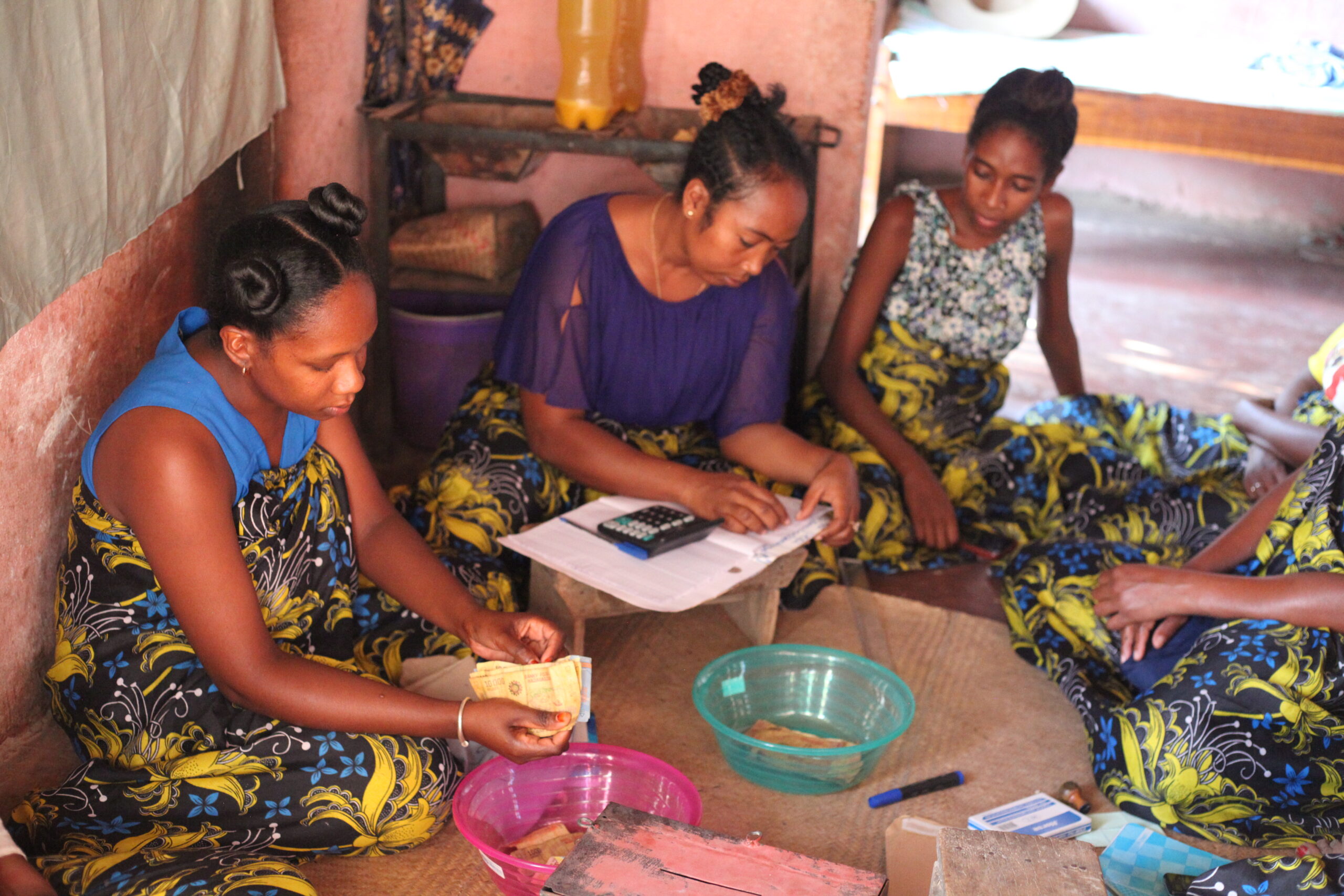
Ms Nadine and Ms Ravoajanahary were members of Money for Madagascar’s Fieres (‘Proud’) project, which delivered power to women and their communities to improve their lives and livelihoods while protecting their environment and overcoming the impacts of climate change on them and their work.
The programme ran in Melaky, Maintirano, a region cut off from the rest of Madagascar for many months of the year, when the road in and out of the region is impassible. Almost all income-generation in Melaky comes from agriculture, and shorter rainy periods and higher temperatures caused by climate change are creating water shortage and soil damage.
This leads to to reduced household incomes, and increased reliance on natural resources – also increasingly also under attack from climate change. Women in particular had little or no access to resources, a low level of education, and little access to information, which made them even more vulnerable.
PROUD, in partnership with SAF Melaky and the Federation of Women’s Associations FIVEMI, trained young women to develop and deliver innovations and information about environmental protection, gender-based violence, the gender approach and positive discrimination, the causes of climate change, and group facilitation techniques.
It also engaged men, to ensure full community engagement and support, and promoted GECs: ‘savings and loans’ groups, through which members – the majority women – could fund innovations to improve incomes and community living standards.
PROUD delivered training to 16 young women aged 20-45, who now share knowledge and skills with communities, and led meetings in which communities considered climate change and its impacts, to develop innovations and projects to respond to them.

We set up 16 GECs, with a total of 362 members – 338 (93 per cent) of them women – which help support climate change adaptation projects with finance.
All of those groups are still running, and have delivered women opportunities which they have taken to help themselves, their families, and their wider communities.
Ms. Nadine, a member of the GEC Al Noor, explained:
‘Thanks to the GEC, I have flourished in society.
‘Before, my husband would never let me leave the house without his permission. By accepting my membership in the GEC and going out for the weekly group meetings, my husband has contributed to my change.
‘With the money I borrowed from the GEC, I opened a small business that helps me feed our family and pay for our children’s school fees.
‘My husband has become proud of me and encourages me to continue my activities because they meet our daily needs. We can save for bigger projects for our family, such as buying furniture or financing our children’s higher education.’
 Ms Ravoajanahary, a member of the GEC Miray Hina, said:
‘I used to be a very poor woman. My friends encouraged me to join the GEC but I thought the group is for the rich, so I was not motivated. Besides, I doubted my ability to contribute.
‘Finally, because of them, I joined the GEC Miray Hina. When I joined, I performed agricultural labour, using some of the money I earnt to pay into the GEC, and the rest to contribute to our family needs.
‘I borrowed money from the GEC to open a small business, which did well, so I could repay my loan and the interest before the deadline. I borrowed even more money afterwards to finance the care and treatment of my child who was hospitalised in Majunga. He is cured now, and we are all more comfortable and happy.‘
GEC and DAF
Joséphine Rasoanantenaina, 52, is part of a GEC we set up in PK7, Andasibe. She runs a shop, and a farm, and is a mother-of-four.
Before joining the GEC, she was – despite her two jobs – only able to make half of what her family needed to stay alive each day.
In the GEC’s first nine months (in 2022-23), the group had 24 members (23 women, one man). Each paid 300 Ariary (around five pence) per week.
At the end of the cycle, Joséphine received 130,000 Ariary, which she used to increase her income.
She said: ‘I spent 40,000 Ariary (£6.64) on two ducks, which I sold for 50,000 Ariary (£8.30).
‘I invested 50,000 Ariary in my shop, so I could increase the stock I had to sell. This might seem simple, but it had a great effect. I more than doubled my income, from 20,000 to 50,000 Ariary per day. I could afford the things we need each day as a family.‘
The following year, 2023-24, she paid 500 Ariary (8.03p) per week membership. At the end of the cycle, she received 170,000 Ariary (£28.82).
She said: ‘I used this money to fulfil a dream. Since I got married, I never had a real comfortable mattress. But I had never had the means to afford it. Thanks to savings, this dream has become reality. I bought a foam mattress.’
Changes like this, which may seem small to us, are a reminder that development is not ‘just’ about ‘economic advancement’, as important as that is, but about what it delivers: personal comfort and an escape from shortage and hardship.
Joséphine is now participating in the GEC’s third cycle, paying 800 Ariary (13p) per week. This time, she plans to renovate her house.
She said: ‘This is something we have needed for a long time, and it’s good that I have a way to plan for it that is achievable and realistic.
‘I really like the community savings group. There is a great atmosphere, solidarity, and above all, I can make my dreams come true. I can improve my family’s life and find other sources of income, beyond what I earn for food and daily expenses.
‘This effective method really helps us out of poverty.’
 In the same month, May 2022, MfM and Mitsinjo introduced a Dynamic Agro-Forestry (DAF) initiative, to which Joséphine, as a local farmer, also immediately signed-up.
We provide training and equipment to help farmers protect, and gain far greater yields from, their fertile soil and the forest, helping them increase income and escape poverty, as well as protect the forest.
She has achieved food security, additional income, and respect for the environment, and has actually decreased the amount of work she has to do.
She explained: ‘Before, I only grew one type of crop on a plot, often without fertiliser. I sowed 10kg of beans and I harvested barely 12kg. The land quickly became barren. I then had to look for another plot, which I burned to cultivate, but after a single harvest, the land also became infertile. It was a never-ending circle.
‘Today, thanks to the DAF technique, I no longer have to leave my plot. It has become fertile and productive all year round. I learned how to make compost, which greatly improved the quality of my crops.
‘I now grow cucumbers, beans, corn, rice, sweet potatoes, and bredes in permanent cultivation.
‘With 10kg of bean seeds, I can now harvest up to five times more than before! I never stop harvesting, every season, and I even have a surplus to sell at the market. I can feed my family without difficulty.
‘The DAF is really a sustainable solution. Thanks to this project, we no longer have food shortages. The whole community is beginning to understand that it is possible to cultivate differently, without destroying the forest. We are deeply grateful to the Mitsinjo Association and all those who helped us learn this new technique.’
 Noeline Ravaoarimalala, 34, is a farmer and mother of three. She also lives in PK7, in Andasibe, where the Mitsinjo Association has been working as a Money for Madagascar partner for the last decade.
She also joined the village’s GEC, which we set up, and as she explains, her life at that point was hard.
She said: ‘Me and my husband survived by working each day in fields belonging to wealthier families. We only had enough money to cover our daily food needs. We were anxious every day in case something happened that would require or cost money. We couldn’t possibly afford it.’
After nine months in which she saved her share of the profit the GEC-supported projects made, she had 130,000 Ariary (£22.05), with which she bought rice, which she sold on for 240,000 Ariary (£40.71).
She said: ‘My husband and I used this money to start a dream. A thing we never thought would be possible. We started to build our own permanent home.’
Noeline stayed with the CSG in 2023-24, when the group had 30 members (28 women, two men), and a weekly membership fee of 500 Ariary (8.5p). She received 170,000 Ariary (£28.84), which she invested in buying gold, which could be sold for twice the price she paid.
She saved what she earnt, and she and her husband continued to build their house.
Today, she is still a member of the GSC, and she, her husband and three children, moved into their new house in April 2025. She has 1.5m Ariary (£254.43) and has for the first time opened a savings account at the Adasibe post office.

She said: ‘Thanks to my savings, I’ve been able to make my dreams come true.
‘Since joining the group, I’m no longer short of money and I can meet my family’s needs. The GSC is a real solution to our daily problems, and I’m proud to be part of it.
‘I hope to go even further in achieving my goals.
‘I can say that the GSC has allowed me to escape poverty. Today, I can dream bigger.’
When you put money, power and agency into the hands of women, and give them the chance to make it work, they do so not just for themselves, but their families and entire communities.
We are delighted to mark International Women’s Day, and to note that Give to Gain is a model by which we empower women, who change and improve their entire society.

adults,
agriculture,
climate,
climate catastrophe,
climate change,
community,
conservation,
DAF,
development,
Dynamic Agro-Forestry,
Dynamic Agroforestry,
environment,
Environmental News,
equality,
farming,
FIERES,
finance,
food,
forest,
gender,
global South,
livelihoods,
loans,
Madagascar,
Malagasy,
Microfinance,
poverty,
PROUD,
rainforest,
RFL,
savings and loan,
women
| Tags:
development,
Dynamic Agroforestry,
Housing,
income,
International Women's Day,
livelihoods,
Madagascar,
Malagasy,
microfinance,
savings and loan,
savings and loans,
women


 English
 Cymraeg
 Français