Miala tsiny fa tsy mbola misy amin’ny teny malagasy ity lahatsoratra ity.
On Thursday 5th June 2025, the World Bank updated its – and the world’s – poverty metric.
Up to that date, the international poverty baseline – the line below which anyone is defined as living in poverty – had been an income of US$2.15 (£1.59 at 8th September 2025) or less per day.
From then, the income per day has increased to US$3 – £2.22 per day.
The World Bank, whose metric is the guide used by every organisation to define poverty, made the update to reflect its ‘purchasing power parity’ research, into the global situation as at 2021. The previous baseline was calculated using the data from the previous research, related to 2017’s PPP.
Some outlets have reported that the change has ‘put’ ‘125 million more’ people in poverty, but even though there are now 817m people classified as living in poverty compared to 692m before the update, of course it has not.
What it has done is more accurately reflect the lived experience of men, women and children experiencing challenges including food insecurity and poor health, in countries across the world. There were already 817 million people living in poverty: the World Bank’s update is just the world catching up with that reality.
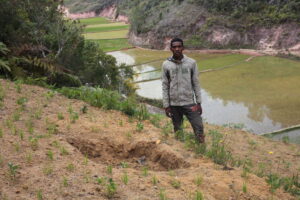
In Madagascar, the situation is extremely stark. Here, the proportion of the population living in poverty has been revealed to be no longer 79.9 per cent – itself a shocking and unacceptable rate – but now 90 per cent.
That is, nine out of ten Malagasy men, women and children are today living on or below the international poverty baseline: 28.764m of Madagascar’s 31.96 million people are living in poverty. Just 319,600 Malagasy people are not.
This is not an ‘acceptable level’ – even if any person living in poverty were.
And these are not ‘just’ numbers. Every one of those people is a person, with a name, a past, with thoughts, feelings, cares and desires. With memories and plans for the future. No-one should be forced to miss meals, go to bed hungry. No child should miss a day of school because of illness brought on by lack of food, or by dirty water. We live on a planet which has never once produced too little for every person to live in comfort and security, and yet Madagascar is a country in which nine in every ten people is forced by poverty to go without.
 We work to enable Malagasy communities to define the challenges they face, and provide the platform, including equipment, training and cash, they need to formulate and enact the solutions to them, while protecting and expanding the rainforests upon which every living thing on Earth relies.
This has always been an urgent matter, and a vital activity.
Madagascar is the world’s fourth-poorest country. Nine out of ten of its men, women and children are living in poverty.
You can help. Donate if you can – we will use the money to help Malagasy people lift themselves from poverty and hunger, and to protect and expand the vital Malagasy rainforest.
And if you cannot, you can still help Madagascar: tell your friends, your family, your colleagues, and tell your elected representative, whoever and wherever they might be, that a country of 31.96m people, which contains one of the most important, and spectacular, natural resources on the planet, is the world’s fourth-poorest state, and that nine in every ten people who lives here, is living in poverty.
We cannot change this alone. But we can if we set out to do so together.
adults,
agriculture,
Aid,
babies,
Biodiversity,
Children,
Children for the Future,
climate,
conservation,
education,
Education for Life,
environment,
equality,
food,
forest,
girls,
global South,
health,
homelessness,
livelihoods,
Madagascar,
Malagasy,
medicine,
poverty,
Protecting and Enabling Vulnerable Children,
rainforest,
Resilient Forests and Livelihoods,
teenagers,
Vulnerable children,
water,
wildlife,
women,
World Bank,
young women


 English
 Cymraeg
 Français