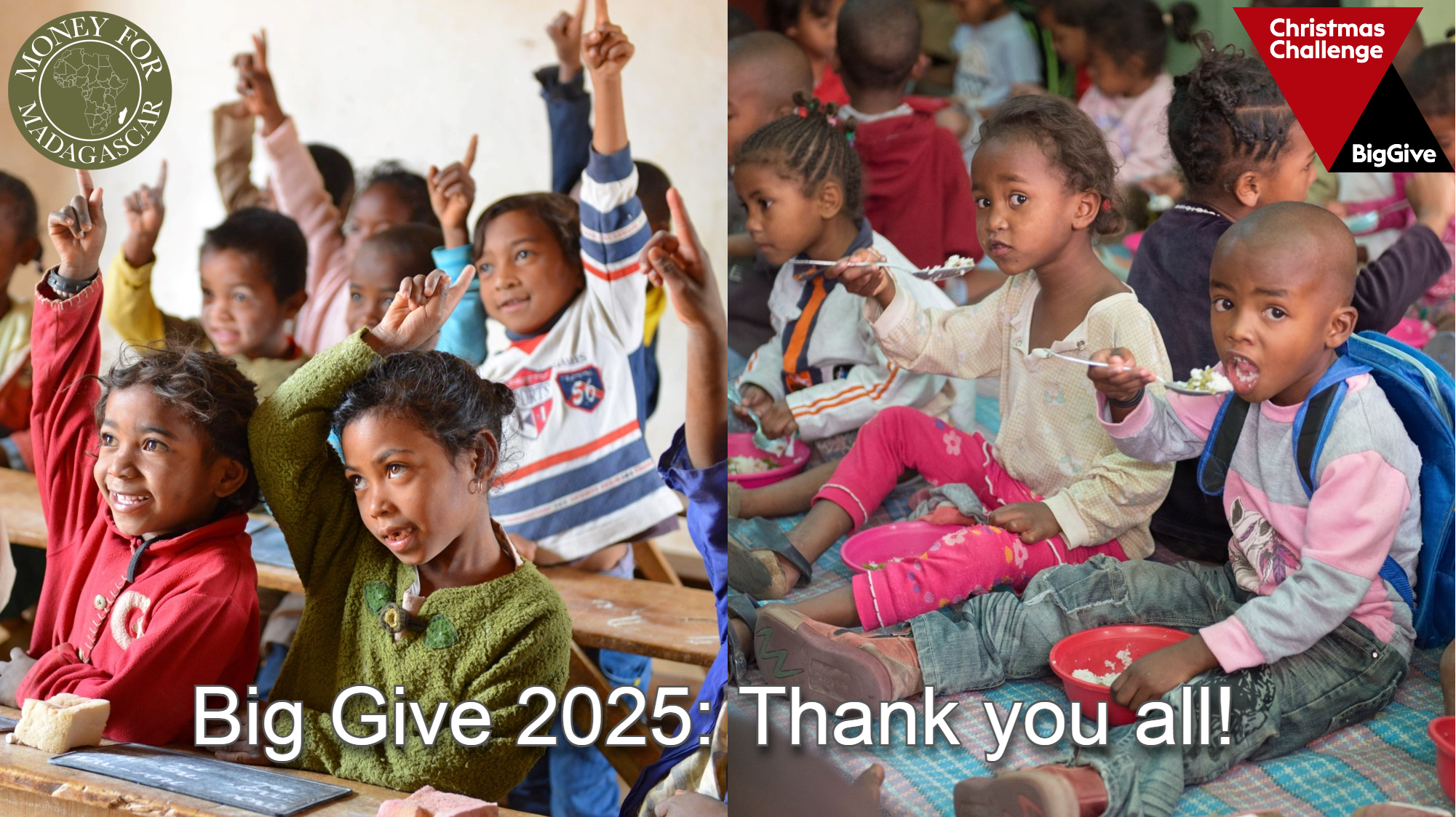
Now the Big Give challenge 2025 has ended, we want to tell you about how together, you and we are going to transform the lives of many more Malagasy children, and of everyone in the communities of which they are part.
This year’s Big Give ran for seven days, from Tuesday 2nd to Tuesday 9th December 2025.
We set our biggest-ever target: £50,000 in donations during the week, which would be doubled in value because of our pre-pledgers and the Coles-Medlock Foundation, our champion fundraiser, to £100,000.
Your response was amazing: thanks to your kindness, generosity and dedication to getting the word out about what we were targeting, and why, we reached our target with two and a half days of the seven days remaining: we got to £50,000 late on Saturday/early Sunday 6th/7th of December.
Thank you so much!
This was doubled to £100,000, and even then, you kept donating, so we finished with a total of £101,602.
And we want to let you know what your donation will do, and why it’s so important.
Madagascar is a beautiful country, with a wealth of extraordinary environmental riches: five per cent of all the world’s species are found here, and of those close to 90 per cent are found only here.
Malagasy people, like people everywhere, are intelligent, motivated and want and deserve to live lives in comfort, the reward for their efforts and innovation.
But Madagascar is the world’s fourth-poorest country. More than 1.32m Malagasy people live in a situation of ‘acute food insecurity’, a term which means they lack sufficient food to meet their basic needs, threatening their health, strength and ability to work: their lives. The next ‘level’ of food shortage is famine.
Many many more Malagasy people suffer hunger daily. Most miss at least one meal a day.
The impact on children is stark. Because of hunger, ill-health and poverty:
Half of all Malagasy children suffer stunting due to malnutrition, and that malnutrition is chronic in 40 per cent of Malagasy young people
One in ten Malagasy children do not reach their tenth birthday
Four in ten Malagasy children do not even finish primary school
Other factors can also threaten the lives, security and potential of Malagasy children. Those who are unable to live with their families are often forced onto the streets, and can end up in adult courts simply as a result of that.
This is why we are targeting £100,000 in next week’s Big Give: so that we can work with Malagasy communities and Malagasy partners to reach those children, their schools and their communities.
We will use the money in our Education for Life (EfL) programme, in which we and our partners:
train teachers and provide books and equipment to make sure children have the highest possible standard of education
improve infrastructure and help families with education expenses to ensure children are not prevented from attending school
improve nutrition, access to food and clean water – with adults as well as with children – to help reduce hunger and sickness and provide children with the best possible chance to fulfil their potential
provide adults with education and the means to improve their livelihoods, so they, too, can fulfil their potential, and help their children learn and live in comfort
And we will use the money in our Children for the Future (CfF) programme, in which we work with our partners to provide children who cannot live with their families with:
shelter
food
healthcare
clean water
clothes
access to education
And the care and attention they need and deserve.
We know these programmes work. We know it because in the last year alone, CfF reached 1,695 children (aged 0-18), 645 of whom were placed in full-time children’s homes.
Of those, all but 27 who are old enough to attend school do so (the 27 entered our partners’ care homes recently and have since entered or re-entered education).
The centres provided 321,464 meals to children, as well as milk to babies, and 78.6 per cent of the young people who live there who took exams this year passed and were able to progress to the next level of schooling.
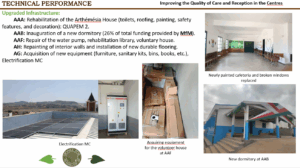
We have led the installation of water supply systems at children’s centres, ensuring hundreds of children have clean water to drink and wash in, without having to travel long, arduous distances to access and bring it to their homes.
At the Akany Avoko Bevalala (AAB) centre, which accommodates vulnerable boys aged 10-18, fetching water had been a daily burden, requiring a 15-minute walk to the nearest water point, followed by a difficult climb carrying the water back.
The only alternative was a shorter walk to nearby rice fields, but this contained its own risks, not least the spread of scabies, a particular problem to vulnerable younger boys.
We ran the installation of borehole and pipes carrying water to the centre.
Two boys who live at the centre, Jolo and Ravo, said: ‘Today, we are relieved: the water is finally here. We no longer have to travel long distances or carry heavy loads. This changes everything for us.
‘Before, we had to walk 15 minutes to reach the nearest water point. Once we arrived, we often waited almost an hour, as this water point is owned by the community and used by many people.
‘Every day, we had to bring back at least twenty 20-litre cans to meet the needs of the center. Each boy had to carry two cans a day, and the climb from the draw point to the center was extremely tiring.
‘This access to water is vital for our well-being and for the proper functioning of the centre.’
As importantly, we have created spaces for these children in which they feel and are cared for, and where they can experience childhood in respect and safety, as every child deserves.
Our Education for Life programme has reached more than 7,000 people in the last year, in 16 school communities in Madagascar.
In that period, we and our partners have trained 98 teachers and installed 14 libraries at 14 schools, and helped 1,275 children whose education was under threat to remain in or return to school.
We have trained 3,848 people in nutrition, and helped ten schools open canteens, providing 2,917 children with nutritious meals, including food from the schools’ gardens, which we also helped them develop.
We trained 2,917 children and 802 adults in school and home hygiene, helped 144 illiterate adults to learn to read and write, and provided 1,810 parents with technical and material support to produce food and/or set up new income-generation initiatives.
We are proud of the fundamental achievement of providing Malagasy adults with the knowledge and equipment they need to lift themselves from poverty and hunger. This in itself is a result worth working for.
And the educational outcomes are also clear: EfL schools achieved a 70 per cent pass rate in school examinations this year, meaning more than two-thirds of children have been able to progress to the next school level at the first attempt.
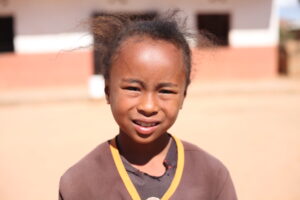
Tsiry is just one child whose life is being transformed.
She explained: ‘My name is Tsiry.
‘I am in eighth grade at EPP Manerinerina.
‘Before, I was very hungry at school and when I came home every day. I live 30 minutes from the school, about three kilometres.
‘We don’t eat food in the morning at home because my parents are very poor, and school lasts until 12:30.
‘Now, thanks to the new school canteen I am no longer hungry when I come home.
‘My studies are also improving because before I had an average of 9/20 at school but now I have 12/20.’
Our programmes work. But the need remains great.
Thanks to your help, your consideration and your generosity, you and we can now reach an even greater number of Malagasy youngsters, transforming their lives and those of the communities in which they live.
Your donations will hugely improve the lives of children, and improve their communities, now and in the future.
They will help us to transform Malagasy lives and communities, many times over.
To access data on Children for the Future in 2024-25, click here.
To find out more about Education for Life in 2024-25, click here.


 Malagasy
 Cymraeg
 Français

 Two boys who live at the centre, Jolo and Ravo, said: ‘Today, we are relieved: the water is finally here. We no longer have to travel long distances or carry heavy loads. This changes everything for us.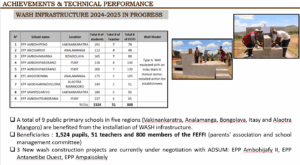
 Tsiry is just one child whose life is being transformed.