Mae’n ddrwg gen i, mae’r cofnod hwn dim ond ar gael mewn English.
A project run by a Malagasy church organisation in partnership with Money for Madagascar is helping women lift themselves from poverty and in some cases, helping them feel included in their community for the first time.
Forty-eight Muslim women in Melaky, Madagascar, have worked together to build a business with assistance from the SAF FJKM Women’s Development Project.
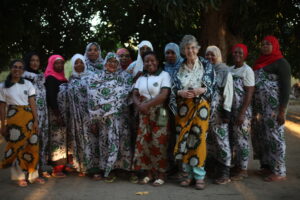
The Project, run in partnership with Money for Madagascar and the Malagasy NGO AMI Miarintsoa and financial support from the French Embassy to Madagascar’s PISCCA programme, uses micro-finance in the form of Community Savings Groups (GECs), where members contribute through a subscription, and then choose initiatives and activities to invest in, sharing the profits.
But for these 48 women, it has had a social as well as a financial impact.
Because the Project is run by the SAF FJKM, the development and outreach arm of the Malagasy Protestant Church, yet has included the Melaky Muslim community in its work.
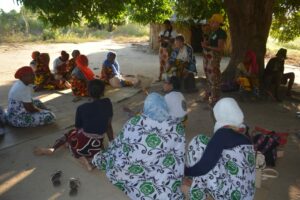 Marie Anne, a resident of Maintirano, and the project’s Focal Point for these 48 women, explained: ‘This is the first time we have heard of a project that is open to all women, regardless of religion. We were touched by this inclusive approach.’
When she heard about the opportunity to take part, Marie Anne trained in how to set up GECs, and gathered women from her community.
Together they created two groups, the Al Noor GEC and Tealongo GEC, one with 30 and the other of 18 members.
The women’s first activity was to buy and breed goats. Each GEC now has 15, and Marie Anne noted: ‘During religious gatherings, community meals often require goats, and there is also a demand for exports to the Comoros.’
From a 2,000 Ariary subscription, each woman has so far received 300,000 Ariary, which they have used to set up new income-generating initiatives, send their children to school and deal with unforeseen situations.
‘In case of urgent need, we can borrow from the GEC and repay according to terms agreed with the members,’ Marie Anne explained.
The goats have already given birth, increasing the herd, and each one can be sold for 150,000-200,000 Ariary.
The women hope they will receive up to 1,000,000 Ariary each at the end of the project’s cycle.
And Anne Marie explains that as well as the economic improvement, the women’s whole family balance has been strengthened.
She said: ‘Our husbands are proud of us. For example, when it’s my turn to look after the goats, my husband helps me to get to the farm, because it’s a bit far from the village where we live. Today, we support each other.
‘We are very grateful to to SAF FJKM and all the project partners for valuing us, respecting our faith, and giving us the means to change our lives.’
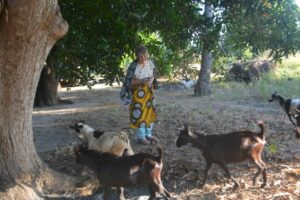 Theresa Haine, a Money for Madagascar Trustee and former director, met the women as part of her visit in May and June this year.
She said: ‘I went to Maintirano and met the SAF/Melaky team, led for the past 30 years or more by Jean-Pierre and his wife Juliette.
‘They have done a lot of excellent work over the years with groups (of mostly women) and helped them plant thousands of trees, grow vegetables, build a covered market-place, run micro-finance groups and countless other activities that enable people to raise sufficient income to feed and clothe their families and send their children to school.
‘I visited to be there for the three-day festival to celebrate 20 years of working with Money for Madagascar and thirty years of working with SAF/FJKM.
‘When SAF was set up 50 years ago, there was a feeling among many of the FJKM (The Church of Jesus Christ in Madagascar (Malagasy: Fiangonan’i Jesoa Kristy eto Madagasikara; FJKM) members that SAF development should only be aimed at church members.
‘But those on the SAF committee were adamant that development should be for everyone, not only for church members.
‘This principle is made very clear to me with the very friendly and welcoming Muslim women who breed goats and ducks.
‘They showed us their flock and the ducks, and it’s so inspiring to see these women included in a Project that is for everyone, and making it work through their innovation and hard work.’
community,
development,
finance,
GEC,
livelihoods,
loans,
Madagascar,
Malagasy,
Microfinance,
Resilient Forests and Livelihoods,
savings and loan,
women


 English
 Malagasy
 Français