Tuesday February 3rd, 2026
Mae’n ddrwg gen i, mae’r cofnod hwn dim ond ar gael mewn English.
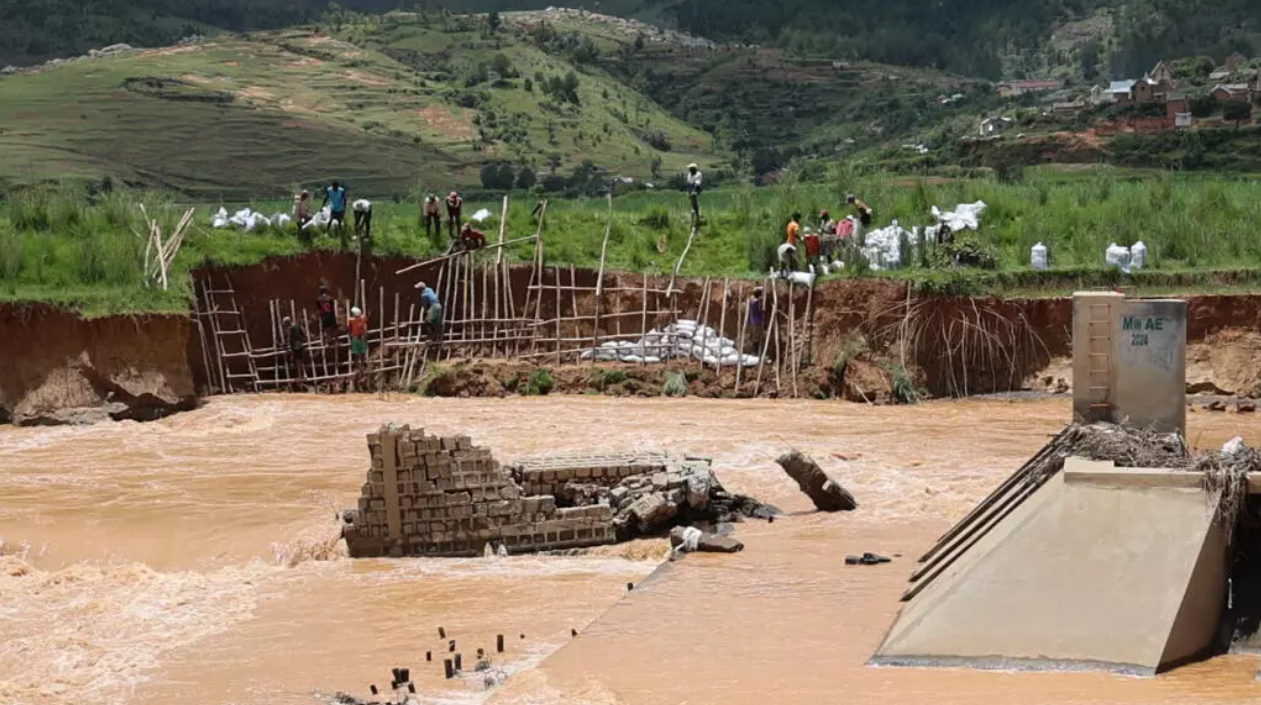
Seven Malagasy people are confirmed to have died, and more than 54,000 injured or otherwise affected, as a result of tropical cyclone Fytia.
The cyclone struck Madagascar – primarily the country’s North-West – on Saturday (31st January 2026) morning, leaving the island on Sunday.
Its wind of up to 210km/h and rainfall destroyed more than 1,400 homes, and flooded more than 9,000 more in 27 regions including the national capital Antananarivo
And more rain is scheduled for the coming days, raising fears of landslides and the collapse of dykes on the Sisaony river.
Madagascar’s National Emergency Operational Coordination Centre (CNCOU) has deployed civil protection teams, water pumps for drainage, and is delivering food to areas including Soalala, Marovoay, and Mahajanga.
But rescue efforts in several communes such as Mitsinjo and Besalampy, are difficult because high water levels make them hard to access.
Madagascar experiences cyclones and tropical storms at around this time of year, every year.
But as we have previously noted, in the last few years, these storms have had greater than average intensity: Cyclone Chido, which struck Mayotte, Agalega and Madagascar in December 2024, was the most powerful storm recorded in Mayotte for 90 years, which the Climate Central group stated was the result of human-caused climate change.
And the threats of landslides and greater flooding are also a serious challenge in Madagascar, a country where 90 per cent of the population lives on or below the global poverty baseline, and 80 per cent rely on agriculture for their income and survival.
Madagascar is one of the world’s only carbon sinks – regions which remove more carbon from the atmosphere than they emit – it is experiencing the impacts of climate change in ways that could devastate its population.
And should Malagasy people require more land to replace what they currently rely on for income and survival, they may well be forced to clear areas of the forest which make Madagascar one of only four carbon sinks on Earth, and upon which we all rely.
Our work with Malagasy communities includes enabling them to protect and increase the productivity of their land, and we are monitoring the situation across the regions in which we work.
But the responsibility for what is happening to Malagasy men, women and children does not lie with them, and cannot be borne by them, even with the assistance of MfM and you, our dedicated supporters
Everyone on Earth relies on Madagascar’s wild spaces, and others like them, under threat all over the world, and it is our responsibility to ourselves – especially the large governments which can afford to – to make sure they are protected, and can thrive.
agriculture,
Antananarivo,
Biodiversity,
climate,
climate catastrophe,
climate change,
conservation,
development,
Dynamic Agro-Forestry,
Dynamic Agroforestry,
environment,
Environmental News,
food,
forest,
global South,
government,
livelihoods,
Madagascar,
Malagasy,
poverty,
rainforest,
Resilient Forests and Livelihoods,
wildlife
| Tags:
agriculture,
carbon,
carbon sink,
Cyclone,
Cyclone Chido,
Cyclone Fytia,
Fytia,
Madagascar,
Malagasy,
rainforest,
responsibility,
tropical storm


 English
 Malagasy
 Français