Friday October 17th, 2025
Mae’n ddrwg gen i, mae’r cofnod hwn dim ond ar gael mewn English.
Colonel Michael Randrianirina of the Malagasy army unit CAPSAT has been sworn in as the new president of Madagascar, just days after carrying out a military takeover of the island.
The change in leadership in Madagascar came as the result of three weeks of social unrest and widespread violence, after young Malagasy people staged a demonstration following increasingly regular cuts to power and water supplies across the country, blamed on the government-owned water and power supply company JIRAMA, which receives ten per cent of the total Malagasy state budget every year, but which was overseeing cuts lasting ten hours or more, several times each month.
In Antananarivo, where the demonstrations began, early reports had suggested five, protestors had been killed by state police: the UN’s High Commissioner for Human Rights Volker Turk, said 22 people had been killed, and at least 100 injured.
The then president Andry Rajoelina questioned this, saying in fact 12 people had been killed, claiming they were all ‘looters and vandals’.
But protests continued, and quickly spread across the Madagascar, with young people and many others defying curfews and government warnings to take back to the streets with an increasing list of grievances, including abuse of human rights, alleged government corruption and extremely low living standards.
Rajoelina dismissed his energy minister Olivier Jean-Baptiste on Friday 26th September, the following Monday (29th September) announced the dissolution of his entire government, but the demonstrations continued.
Last Saturday (11th October 2025), amid claims that a member of the Malagasy gendarmerie (military police) had shot a CAPSAT soldier, the unit announced it would no longer ‘follow illegal orders {to} fire on our brothers and sisters {protestors}’ and instead joined the protests on the streets.
On Sunday, reports suggest that Rajoelina fled the country, claims which have not been definitively confirmed, and in a speech late on Monday (13th September 2026) said he had gone into hiding because of ‘threats to {his} life’.
On Tuesday 14th October, hours after Rajoelina attempted to dissolve the Malagasy parliament’s Lower House, parliament (including many members of his own party IRMAR) voted to impeach him.
Moments later, Randrianirina announced that the president’s office would be replaced with a council made up of officers from CAPSAT, gendarmerie and police, adding that: ‘Perhaps in time this council will contain senior civilian advisers.’
He said that the council would ‘in the coming days’ appoint a Prime Minister, whose job would be to select a civilian government, adding that elections would come after he and his colleagues had ‘formed a consensus’, estimating this may take ’18 months to two years’.
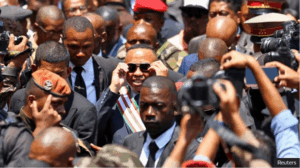
At his signing-in, Randrianirina said the problems Madagascar had faced in the last three weeks were ‘the result of the constitution’, which he said he and his colleagues would replace. He also appeared to push the appointment of a new prime minister, and therefore also a civilian government, down his list of priorities.
He said: ‘I will dedicate all my strength to defending and strengthening national unity and human rights.
‘We will work hand in hand with all the driving forces of the nation to draft a fine constitution. We will reform the electoral process before the next election.
‘We are committed to breaking with the past. Our main mission is to thoroughly reform the country’s administrative, socio-economic and political systems of governance.’
After the ceremony, he said: ‘Today and tomorrow, we will examine the situation at Jirama – what is happening there and what problems currently exist. This review aims to prevent further difficulties in the future. That is our first social priority.
‘The second priority is rice farming. As we enter the agricultural season, we must assess how best to proceed.
‘The third priority is the appointment of the prime minister and formation of the government.’
The BBC reports also that it is widely believed that Randrianirina appears – like many new military leaders to have taken power in African nations since 2020 – to be seeking closer ties with Russia, which could alter Madagascar’s relationship with France.
On Thursday, the broadcaster reports, Randrianirina attended a meeting with Russian embassy officials to reportedly discuss ‘serious’ co-operation between the two countries.
During the protests, some demonstrators had been seen on the streets waving Russian flags and calling for Moscow’s intervention.


 English
 Malagasy
 Français