Tuesday November 11th, 2025
World leaders have gathered in Belem, Brasil under the ongoing shadow of the climate catastrophe, for the 30th UN Climate Change Conference (COP30).
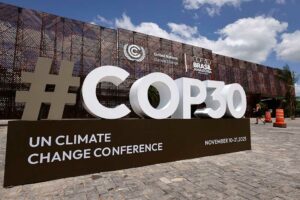
The summit has begun with the world in an unprecedented level of risk from – and in the case of Madagascar experience of the impacts of – climate change, but serious questions must be asked about who is taking part, who is not in the room, and whether we can expect any of the urgent collaboration we need to address the crisis even to be agreed, let alone acted on.
The deepening crisis
Delegates from more than 190 countries attended the conference’s first day, in the wake of the World Meteorological Organisation (WMO) announcing that 2025 will be either the third or the second hottest year on record.
This projection is all the more serious because it means the last three years will have been the three hottest since records began, and the last 11 the 11 hottest. In its report, The WMO said it is now ‘almost impossible’ for the world to limit global heating to the 1.5°C above preindustrial levels, as agreed in the Paris Agreement ten years ago.
In doing so, the WMO has joined UN Secretary General Antonio Guterres and the UN Environment Programme, who have also announced the impossibility of achieving the target, in the last week.
And in a letter published this morning (Monday 10 November 2025), scientists and researchers from dozens of universities and science institutions warned that the world’s glaciers, ice sheets and frozen spaces are thawing at an unprecedented rate.
They said: ‘The cryosphere is destabilising at an alarming pace. Geopolitical tensions or short-term national interests must not overshadow COP30. Climate change is the defining security and stability challenge of our time.’
Despite these serious indications and warnings about the ongoing catastrophe, UN Climate Change Executive Simon Stiell devoted a part of his opening address to attempting to encourage delegates not to work against one another.
He said: ‘In this arena of COP30, your job here is not to fight one another – your job here is to fight this climate crisis, together. Three decades of UN climate talks have helped bend the curve in projected warming downward, because of what was agreed in halls like this, with governments legislating, and markets responding. But I am not sugar-coating it. We have so much more work to do.’
US president Donald Trump, who has for the second time pulled his country out of the Paris Agreement, has refused to send a delegation to the talks, even though the US is the world’s largest emitter of carbon. He once again, incorrectly, claimed climate change is a ‘hoax’.
In his address to the summit, Brasil’s president Luiz Inacio Luca da Silva said: ‘It’s time to deliver another defeat to the denialists.’
What happened at the last COP?
COP29 was widely regarded – with justification – as a failure, particularly when delegates from wealthy nations held out against the calls by countries in the global south for funding for climate mitigation, adaptation and loss and damage. They had requested US$500bn-US$1tn per year by 2030.
Even though many of the wealthier nations agreed that this was what was necessary (on the advice of climate and economics experts), those states’ delegates instead agreed only at the last minute to provide US$300bn per year by 2035.
They did pledge that an extra US$1tn would be raised from businesses and corporate sources, but none of the latter had then been contacted and it is still far from clear whether that money can be found.
And the gap between the world’s wealthy and poorer states, and its more and less powerful people, is further underlined with a look at who will be ‘in the room’.
A widening gap
Many of the world’s poorer countries have had to significantly cut down on their delegation size because of the sheer cost of staying in Belem, with hotel rooms costing US$1,000 per night, US$14,000 per person for the full fortnight.
Most countries will be represented, but the world’s poorest – many of which are the world’s most vulnerable to climate change – will have significantly smaller presence than their wealthier colleagues, and at considerably greater inconvenience.
Michel Omer Laivao, from the Malagasy environment ministry, told AP: ‘We found an apartment in town to share between us. We are relatively happy, though it was difficult to find anywhere to stay, and it’s an hour by bus from the conference centre.’
The Malagasy delegation will discuss a long-awaited climate gender action plan, in which we hope the vital role played by women in Malagasy and global economic activity will be properly recognised and greater opportunity given to women and girls to use their experience and initiative to improve environmental protection.
They will be engaged in the ongoing 30×30 global plan, under which 30 per cent of all the world’s oceans, wilderness and fresh water will be appropriately protected and managed within the next 30 years. As ever, the conversations here must focus on the money states including Madagascar need to carry out this vital task.
And they will be part of ongoing discussions surrounding the Blue Nationally Determined Contributions Challenge, under which participating nations commit to sustainably managing, conserving and restoring coastal and marine ecosystems.
Who will be absent?
But even as they discuss and debate matters vital to Malagasy people and the world at large, others – including many Malagasy organisations and the communities experiencing the realities of the climate catastrophe in their own lives – have been unable to afford to attend.
And this matters.
Because one small group who did make it to COP30 today, indigenous leaders from communities in the Andes, travelled 3,000km (1,864 miles) by boat to demand more say in how their lands are being managed as climate catastrophe hits them ever harder and industries including mining, logging and oil drilling take ever more of their land.
Pablo Inuma Flores, an indigenous leader from Peru, said: ‘We want to make sure that they don’t keep promising, that they will start protecting, because we as Indigenous people are the ones who suffer from these impacts of climate change.’
The same is true of Malagasy communities.
They, too, are facing the increasing devastation and deprivation caused by climate catastrophe, despite being one of only four countries on Earth which removes more carbon from the atmosphere than it emits.
Unicef reports that Madagascar is one of the ten most exposed countries to the impacts of climate change, and is facing more intense cyclones, prolonged droughts, growing food insecurity, and economic losses estimated at over US$1 billion, despite being the world’s fourth-poorest country with around 90 per cent of its population living on or below the global poverty baseline.
In just the last two decades, Madagascar and its people have endured 45 cyclones, 18 floods, and seven severe droughts, affecting more than ten million people in a total population of 32 million.
We demand change, and action
Malagasy men, women and children face severe challenges including food scarcity, disease (including that worsened by climate-related impacts) and the ongoing loss of fertile soil. At the same time, they are being expected to take responsibility for some of the most vibrant, vital wilderness on the planet, itself under direct threat from industry and people’s need to grow food.
With this in mind, we note that it is fundamentally unacceptable to hold conferences such as this without direct participation of and input from the people experiencing the climate catastrophe every day, who the rest of the world expects to protect the natural environment on which we all rely, and who have the experience, knowledge and dedication, but still not the finance and opportunity to do so.
If COP refuses to be the place those people are heard, we must create another, where they are.
With that noted, we hope not just progress but workable agreement and immediate action can be taken on gender and climate, on the 30×30, on the funds available for nations including Madagascar to mitigate against and recover from climate change and its devastating impacts and daily challenges.
We call for the world to put Malagasy communities, and their contemporaries across the global south, at the heart of conversations about matters which affect and impact them now, on which they, too, are experts, and which they are in the end, even if seldom explicitly, called on to mitigate and prevent from happening to others.
We call for climate debt to be cancelled, for the world to commit – and commit finance and expertise to – enabling Malagasy people to be food secure through agroecology, just, equitable energy transition in states which are still being targeted by carbon-burning industries, and the protection and expansion of the world’s great wildernesses, including Madagascar’s incredible wild space, and every plant and animal species within them.
We call for climate policies which guarantee Malagasy people’s right to health, participation and education, and which place Malagasy communities at the heart of any and all measures which will affect and involve them.
We call for the drastic reduction of global emissions to keep temperature rises to as close to 1.5°C as possible, if it is now beyond our capacity to keep them lower than that, and we call for action: not just agreements, or grudging pledges to deliver at some point far less than the global south and the entire world needs right now, but action.
We need a workable plan on which we can deliver from the first day it is agreed.
None of what we are asking for is impossible. And we – Malagasy people, but in fact every person and indeed every living thing on the planet – need all of this, now.
agriculture,
Biodiversity,
climate,
climate catastrophe,
climate change,
community,
conservation,
development,
Dynamic Agro-Forestry,
Dynamic Agroforestry,
environment,
Environmental News,
farming,
food,
forest,
gender,
global South,
health,
livelihoods,
Madagascar,
Malagasy,
Microfinance,
poverty,
power,
rainforest,
Uncategorized,
water,
wildlife,
women
| Tags:
30x30,
action,
biodiversity,
climate action,
community,
conservation,
COP23,
Environment,
food,
incusion,
Madagascar,
Malagasy,
rights


 Malagasy
 Cymraeg
 Français