Friday January 16th, 2026
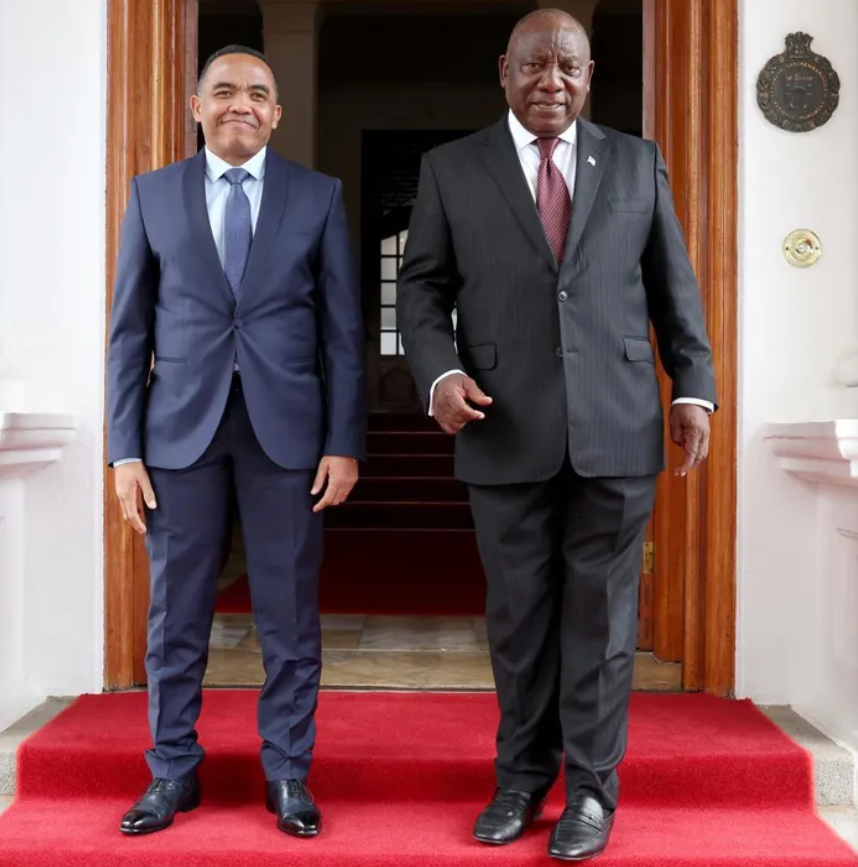
Madagascar’s head of state Michael Randrianirina has arrived in South Africa for conversations with the latter state’s president Cyril Ramaphosa.
The two are expected to discuss Malagasy-South African relations, as well as the situation in Madagascar and perhaps the steps the island-republic is taking towards its first national elections since the removal from power of previous president Andriy Rajoelina in October 2025.
As we noted, Rajoelina fled Madagascar after close to three weeks of civil unrest, which began with protests against electricity and water supply cuts across the country, and developed into widespread unrest and resistance to state efforts to violently prevent and counter the demonstrations.
A turning-point in the events came when the Malagasy army’s CAPSAT unit, led by Randrianirina, announced it would back the public protests, and ordered its members not to obey any illegal orders’ to open fire on the protestors.
Randrianirina was named president of Madagascar on Friday 17th October 2025, and pledged to appoint a civilian government within two weeks (a pledge which was fulfilled), root out corruption, improve public services and hold full elections ‘in 18 months to two years’.
He heads the ‘presidential council’ which also includes members of the Malagasy military and national police force, and in December 2015 announced a ‘national consultation’ which is being led by Malagasy State Minister Hanitrianaina Razafimanantsoa.
The Consultation is designed, Randrianirina said, to ‘drive constitutional reform’ and form the basis of the ‘Fifth Malagasy Republic’.
It will start at the fokotany level, progressing through communes, districts and regions of Madagascar and, Randrianirina said, should enable the entire population to express aspirations and opinions regarding the country’s governance, laws and constitution.
On an international level, Randrianirina is known to have met twice since taking office with representatives of the Russian government – perhaps a reflection of the latter state’s wider efforts to gain greater influence in Africa – but has publicly stated he is open to meetings and cooperation with all the international community, including France, to ‘move forward hand in hand’.
He has called on the world to engage, saying ‘now is not the time’ to ‘abandon {the} country’.
His meeting with Ramaphosa, head of state of the wealthiest nation in the Southern African Development Community, could be an indication that this call is being heard, especially because South Africa was outspoken during the demonstrations and uprising, expressing its ‘concern’ and calling for ‘calm and a respect for democratic processes, a peaceful resolution, the protection of democracy, the rule of law, and sustainable development in Antananarivo.’
South Africa and Madagascar’s diplomatic relations restarted in 1994, after the end of the apartheid regime in Pretoria, and the countries have agreements covering air transport, merchant shipping, and science and technology, alongside their political cooperation.
The South African government described Randrianirina’s visit as ‘part of ongoing regional diplomatic efforts to strengthen bilateral ties while promoting stability and constitutional governance in Southern Africa.’
African Union,
Antananarivo,
community,
development,
Fifth Republic,
France,
government,
Madagascar,
Malagasy,
Rajoelina,
Randrianirina,
SADC


 Malagasy
 Cymraeg
 Français