Monday January 26th, 2026
As the new year begins, we wanted to share with you the latest information about our major programmes, to show you how your support and help is making an impact and improving Malagasy lives and the Malagasy biosphere.
Renewable World’s three main programmes are Renewable Forests and Livelihoods, Children for the Future and Education for Life (we are also part of the Solar United Madagascar consortium, working to ensure Malagasy communities have access to power, all of which is generated from renewable resources and technology).
All three work to directly address issues facing and threatening Madagascar’s environment, flora and fauna, and Malagasy people, providing Malagasy communities with the space they need to define the challenges they face, and supporting them to deliver their solutions.
Almost 90 per cent of plant and animal species in Madagascar are found only here, and the island contains five per cent of all the world’s species of flora and fauna.

But Madagascar has the world’s fourth-highest rate of deforestation.
It has already lost 80 per cent of its natural areas and loses around 200,000ha. to deforestation each year.
At the current rate of deforestation, the complete loss of Madagascar’s forests will happen within 40 years.
And more than 600 Malagasy plant and animal species are threatened with extinction. More than 3.900 (3,912) are ‘endangered’.
Not only is this unacceptable because those animals and plants have as great a right to exist as every person does, it is also a genuine crisis because we all – including every person – depend on our forests for survival.
And Malagasy people, too, face serious existential challenges.
The country’s population is one of the world’s poorest: 90 per cent of Malagasy people live on or below the global poverty baseline of £2.22 per day. Eighty per cent rely entirely on agriculture for their income and survival.
Even though Madagascar is one of only four countries recognised to remove more carbon from the atmosphere than it emits (a ‘carbon sink’), the country is experiencing some of the worst impacts of the carbon catastrophe to date, including drought, flooding and the permanent loss of fertile soil due to extreme rainfall events.
The reality facing most Malagasy men, women and children is that food shortage, hunger and its impacts, including stunting in nearly 50 per cent of children due to malnutrition, are not just a threat, but a reality.
Understandably, one way they try to improve their lives is by removing forest to access more land, and produce more food.
Poverty and hunger also have serious impacts on young people.
One in ten Malagasy children do not reach their tenth birthday. Four in ten do not complete primary school, and hunger, illness and lack of resources prevent many more from regularly attending school.
Education is a fundamental human right, yet the shocking and unacceptable reality is that tens of thousands of Malagasy children either cannot attend school, or are unable to fulfil their potential within it.
Children who are unable to live with their families in Madagascar can also be placed at serious risk, and face challenges even to survive.
Many are forced to become homeless and are at risk of assault or being pushed into crime to escape physical danger and starvation.
All three of our major programmes are designed to not only meet these challenges, but to enable Malagasy people to formulate and deliver the solutions to them: we support Malagasy people to create and achieve solutions to Malagasy problems.
Education for Life (EfL) works with our Malagasy partners and communities to improve education and access to it for thousands of youngsters and in many cases adults each year.
We and our partners:
-
train teachers and provide books and equipment to make sure children have the highest possible standard of education
-
improve infrastructure and help families with education expenses to ensure children are not prevented from attending school
-
provide equipment including tablets, books, educational games and school kits (pens, pencils, bags, exercise and text books)
-
improve nutrition, access to food and clean water – with adults as well as with children – to help reduce hunger and sickness and provide children with the best possible chance to fulfil their potential
-
provide adults with education and the means to improve their livelihoods, so they, too, can fulfil their potential, and help their children learn and live in comfort
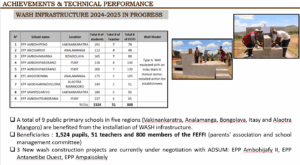
In the last year, we have reached more than 7,000 people in 16 school communities in Madagascar.
We and our partners have trained 98 teachers and installed 14 libraries at 14 schools, and helped 1,275 children whose education was under threat to remain in or return to school.
We have trained 3,848 people in nutrition, and helped ten schools open canteens, providing 2,917 children with nutritious meals, including food from the schools’ gardens, which we also helped them develop.
We trained 2,917 children and 802 adults in school and home hygiene, helped 144 illiterate adults to learn to read and write, and provided 1,810 parents with technical and material support to produce food and/or set up new income-generation initiatives.
We are proud of the fundamental achievement of providing Malagasy adults with the knowledge and equipment they need to lift themselves from poverty and hunger. This in itself is a result worth working for.
And the educational outcomes are also clear: EfL schools achieved a 70 per cent pass rate in school examinations this year, meaning more than two-thirds of children have been able to progress to the next school level at the first attempt.
Tsiry is just one child whose life is being transformed.
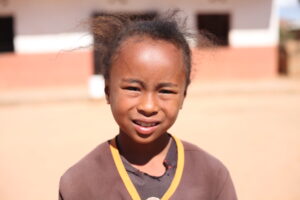 She explained: ‘My name is Tsiry.
‘I am in eighth grade at EPP Manerinerina.
‘Before, I was very hungry at school and when I came home every day. I live 30 minutes from the school, about three kilometres.
‘We don’t eat food in the morning at home because my parents are very poor, and school lasts until 12:30.
‘Now, thanks to the new school canteen I am no longer hungry when I come home.
‘My studies are also improving because before I had an average of 9/20 at school but now I have 12/20.’
In our Children for the Future (CfF) programme, we work with our partners to provide children who cannot live with their families with:
-
shelter
-
food
-
healthcare
-
clean water
-
clothes
-
access to education
And the care and attention they need and deserve.
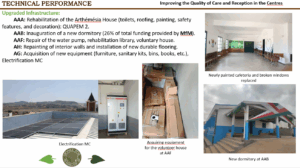 In the last year alone, CfF reached 1,695 children (aged 0-18), 645 of whom were placed in full-time children’s homes.
Of those, all but 27 who are old enough to attend school do so (the 27 entered our partners’ care homes recently and have since entered or re-entered education).
The centres provided 321,464 meals to children, as well as milk to babies, and 78.6 per cent of the young people who live there who took exams this year passed and were able to progress to the next level of schooling.
We have led the installation of water supply systems at children’s centres, ensuring hundreds of children have clean water to drink and wash in, without having to travel long, arduous distances to access and bring it to their homes.
At the Akany Avoko Bevalala (AAB) centre, which accommodates vulnerable boys aged 10-18, fetching water had been a daily burden, requiring a 15-minute walk to the nearest water point, followed by a difficult climb carrying the water back.
The only alternative was a shorter walk to nearby rice fields, but this contained its own risks, not least the spread of scabies, a particular problem to vulnerable younger boys.
We ran the installation of borehole and pipes carrying water to the centre.
 Two boys who live at the centre, Jolo and Ravo, said: ‘Today, we are relieved: the water is finally here. We no longer have to travel long distances or carry heavy loads. This changes everything for us.
‘Before, we had to walk 15 minutes to reach the nearest water point. Once we arrived, we often waited almost an hour, as this water point is owned by the community and used by many people.
‘Every day, we had to bring back at least twenty 20-litre cans to meet the needs of the centre. Each boy had to carry two cans a day, and the climb from the draw point to the centre was extremely tiring.
‘This access to water is vital for our well-being and for the proper functioning of the centre.’
As importantly, we have created spaces for these children in which they feel and are cared for, and where they can experience childhood in respect and safety, as every child deserves.
In Renewable Forests and Livelihoods, we:
-
provide Malagasy people training, information and the equipment they need to increase their access to food and their incomes, through innovative farming methods and new income-generating initiatives
-
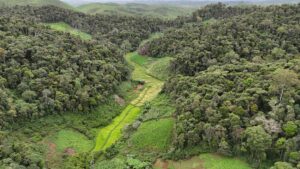
enable them to lead the protection and expansion of the Malagasy rainforest, including the animals and plants for which it is home

We help Malagasy people replant and maintain forests, engage in Dynamic Agro-Forestry (DAF) and Climate-Smart Agriculture (CSA), which help people retain fertile soil, produce more food and expand the forest with plants which can generate income, as well as forest stewardship, training positions and plant cultivation roles.
We also set up Community Based Savings Groups (CSBGs), savings and loans groups in which Malagasy people pool their money, fund initiatives they choose and share in the profits and successes which come from the group’s decisions and investments.
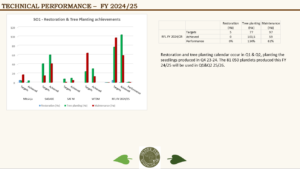 And as of April 2025, with six months remaining of the programme’s pilot, we are delighted to report significant successes, including
-
The reforestation of 268.5 hectares, close to seven times more than our target for the pilot
-
More than 7,500 people benefitting from climate smart agriculture (CSA)* – 4,284 more than our target
-
112 hectares and almost 1,300 households using and benefitting from DAF – almost 50 hectares and more than 1,000 households more than our target
-
241 CBSGs with 5,143 members, 185 more groups, and more than more 4,000 members than our target
Your support – financial and in sharing this information and our updates – is vital to all we achieve, and is central to us being able to continue. Thank you for it.
You can find out more about Resilient Forests and Livelihoods here, and our last financial year here.
To access data on Children for the Future in 2024-25, click here.
To find out more about Education for Life in 2024-25, click here.

AAA,
AAB,
AAF,
AAH,
agriculture,
Ankizy Gasy,
Biodiversity,
Children,
Children for Life,
Children for the Future,
climate,
climate catastrophe,
climate change,
community,
DAF,
development,
Dynamic Agro-Forestry,
Dynamic Agroforestry,
education,
Education for Life,
environment,
equality,
farming,
food,
forest,
gender,
girls,
global South,
health,
homelessness,
lemur,
livelihoods,
Madagascar,
Malagasy,
Partnerships,
poverty,
Protecting and Enabling Vulnerable Children,
rainforest,
Resilient Forests and Livelihoods,
RFL,
savings and loan,
SUM,
water,
wildlife,
women


 Malagasy
 Cymraeg
 Français